How Plynth turns public planning information into traceable answers.
The source remains the authority. Plynth resolves which material applies, records its provenance and shows the evidence used in an answer so the reasoning can be independently checked.
Resolve the land before selecting the law.
Planning rules are spatial. Plynth begins with the parcel and its mapped context: local government area, zone, mapped standards, overlays, hazards and other constraints. That site context determines which instruments and provisions should be considered for the question being asked.
A broad text search can find a relevant clause while missing whether it applies to the selected land. Site resolution is the first control against that error.
Keep the public instrument visible behind the answer.
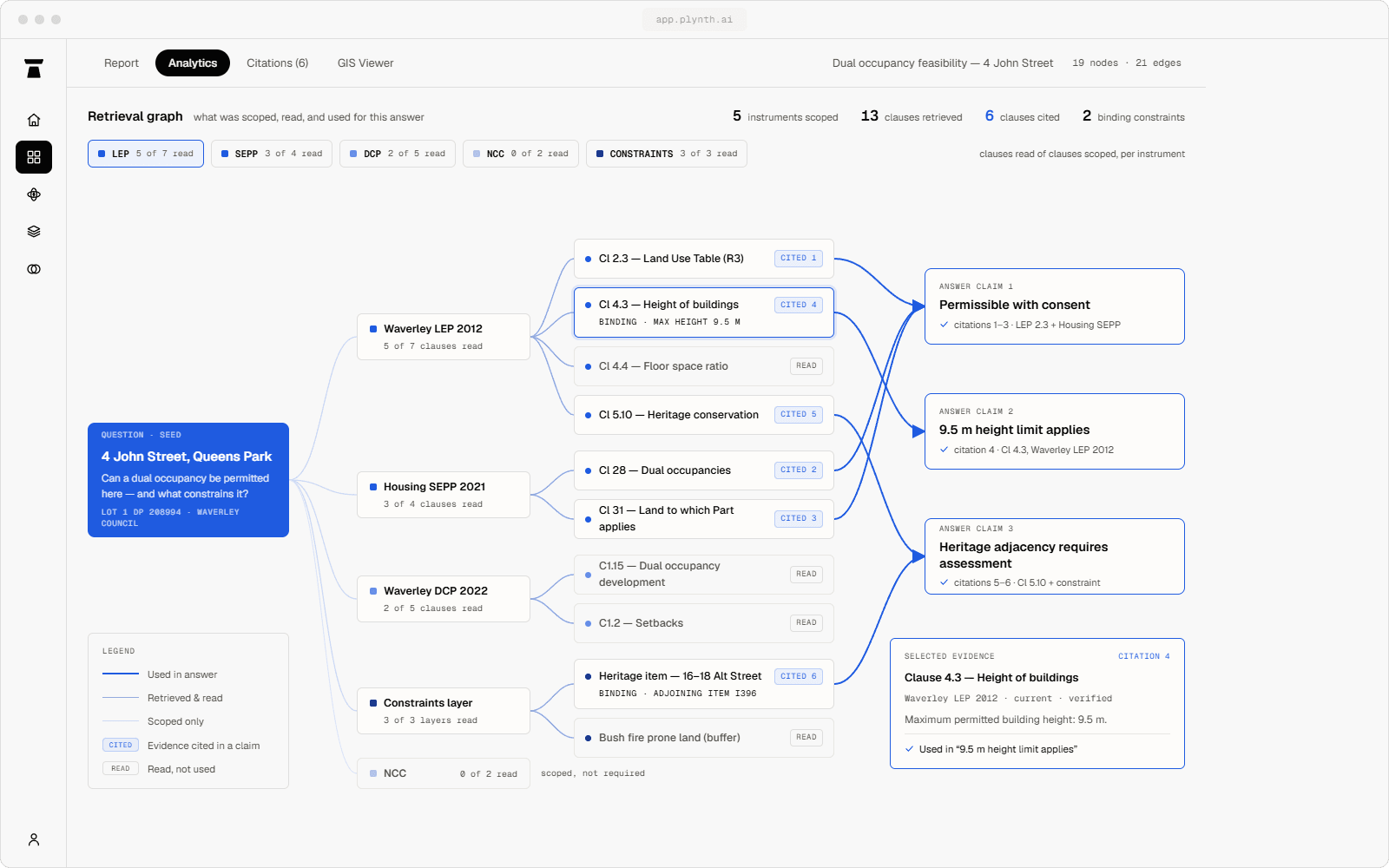
Plynth indexes public planning and building material for retrieval, but does not become the legal source. Answers retain the instrument name, provision, effective context and the exact passage used to support a claim.
Retrieval is intentionally broader than the final citation set. The audit trail distinguishes material that was scoped, read and ultimately used, so a user can see what informed the result.
Assign compliance status with deterministic rules.
Where a control and its inputs are measurable, Plynth evaluates it with code and returns pass, fail or undetermined. The language model explains the result; it does not privately decide the compliance status.
Merit questions, design quality and other discretionary matters are labelled as requiring assessment. This preserves an honest boundary between computation and professional judgement.
Describe freshness by dataset, not with one blanket claim.
Different sources change on different schedules. Development activity is refreshed nightly where the production feed supports it. Planning instruments, maps, judgments and statistical series are versioned according to their own publication and ingestion cycles.
Plynth exposes source and effective-date information where it is available. “Current” should therefore be read as a property of a specific source record, not a promise that every public dataset changes in real time.
Use Plynth to accelerate diligence, not to remove it.
Plynth supports planning research and documentation. It does not replace legal advice, a planning certificate, survey evidence or the project-specific judgement of a qualified practitioner. Material conclusions should be checked against the linked public source and the facts of the site.
Primary public references
These services remain the public authority for the material they publish. Their inclusion here does not imply endorsement of Plynth.