Planning policy research with the source beside the answer
Plynth supports planning policy research by searching the relevant NSW source set and keeping the provision, source identity and cited words beside the answer. Acts, EPIs, local controls, the NCC and judgments remain distinct source types.
The citation shows the material used for a claim. It does not decide project-specific applicability or turn current NSW coverage into a complete Australian policy corpus.
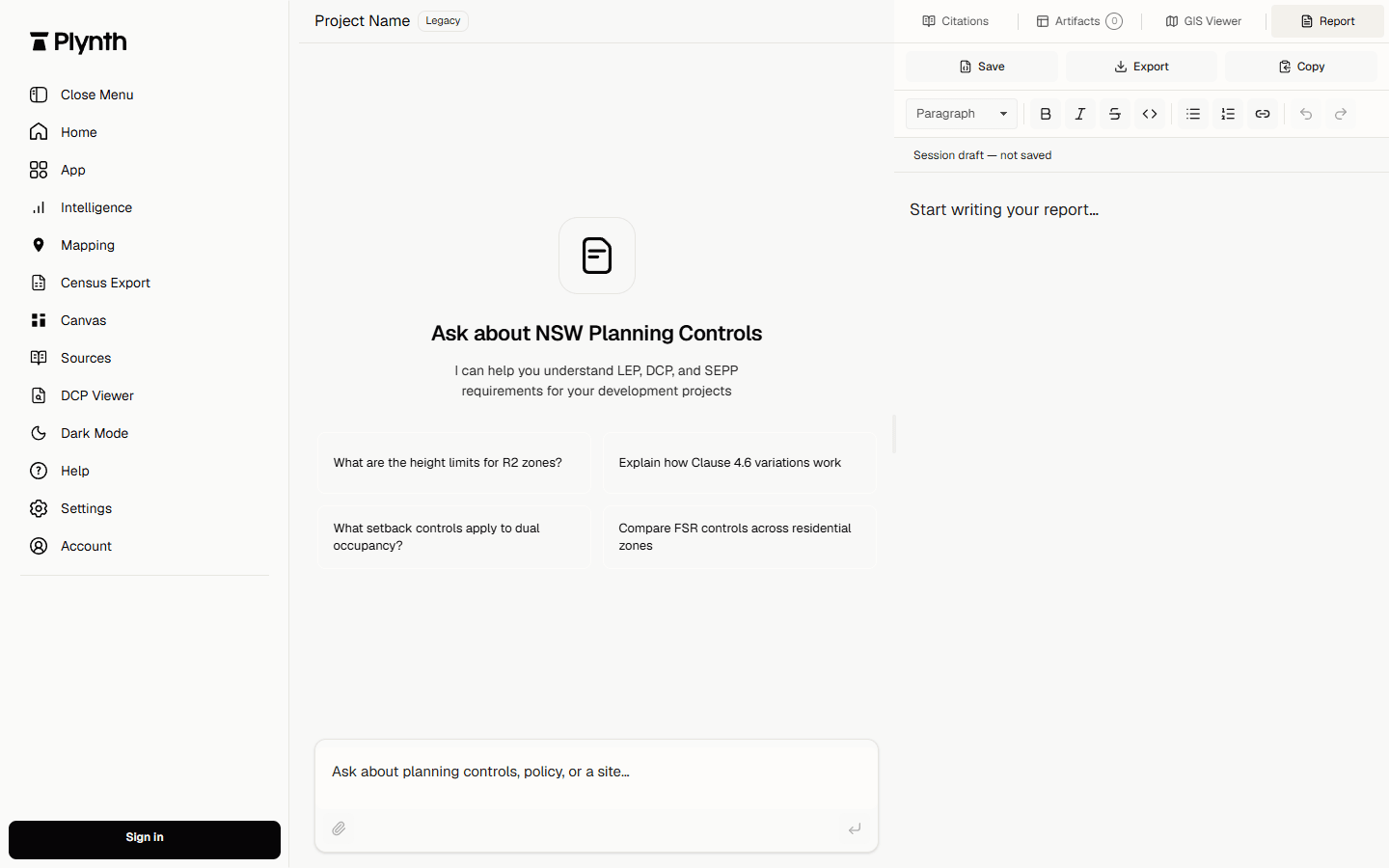
Start with the site and proposal, not a detached keyword.
A useful policy question states the land, proposal and issue being tested. That framing narrows the source set and makes it possible to see when an answer depends on a missing fact.
A broad keyword can return relevant material, but relevance alone does not establish that the material applies to the project.
Search the relevant instrument set in plain English.
Plynth searches across NSW planning instruments, building-code material and planning judgments while retaining the source type. It does not flatten an Act, EPI, DCP, code provision and judgment into interchangeable evidence.
Current coverage is described source by source. A missing local document or unavailable version remains a visible gap.
Open the words supporting each material claim.
A material answer should identify the official publisher, the provision or decision and the words used to support the claim. That allows a practitioner to test the answer against the source.
The source remains the authority. Plynth accelerates retrieval and explanation without replacing the check.
Keep effective dates separate from checked dates.
The date a source was checked is not necessarily its commencement date, data vintage or project applicability date. Plynth records those positions separately where the source provides them.
That distinction matters when an instrument has changed, a transitional provision applies or an older project must be tested against an earlier source position.
A policy answer is useful when its evidence can be reopened.
The current capture shows where conversation and report work begin, not a completed cited answer. The evidence contract below states what must remain attached to a material policy claim.
| Subject | Finding | Source | Boundary |
|---|---|---|---|
| Question | Site, proposal and policy issue stated before retrieval. | Practitioner input and resolved site context | A changed proposal can change the relevant source set. |
| Candidate source | Acts, EPIs, local controls, code and judgments kept distinct. | Named official publisher | Coverage is source-specific rather than assumed complete. |
| Supporting words | Provision or passage retained beside the answer. | Official source text | The extract supports the claim but may not resolve applicability. |
| Date context | Version, effective position and checked date recorded where available. | Official version history and source metadata | Project transitional provisions still require review. |
What this workflow does not establish.
- Plynth does not represent every local source, historical version or Australian jurisdiction as complete.
- A cited provision does not, on its own, decide how a discretionary test applies to a project.
- The National Construction Code edition that applies to a project depends on State or Territory adoption and transitional settings.
Check the source and its date position.
These sources support the public explanation and worked specimen. The official publisher remains the authority.