Planning due-diligence software that keeps unresolved questions visible
Plynth supports early planning due diligence by bringing the parcel, mapped controls, hazards, infrastructure and nearby development context into one source-linked record. Observed facts stay separate from questions that still require assessment.
It is a planning screen, not title or ownership verification, financial feasibility, a planning certificate or an approval prediction.
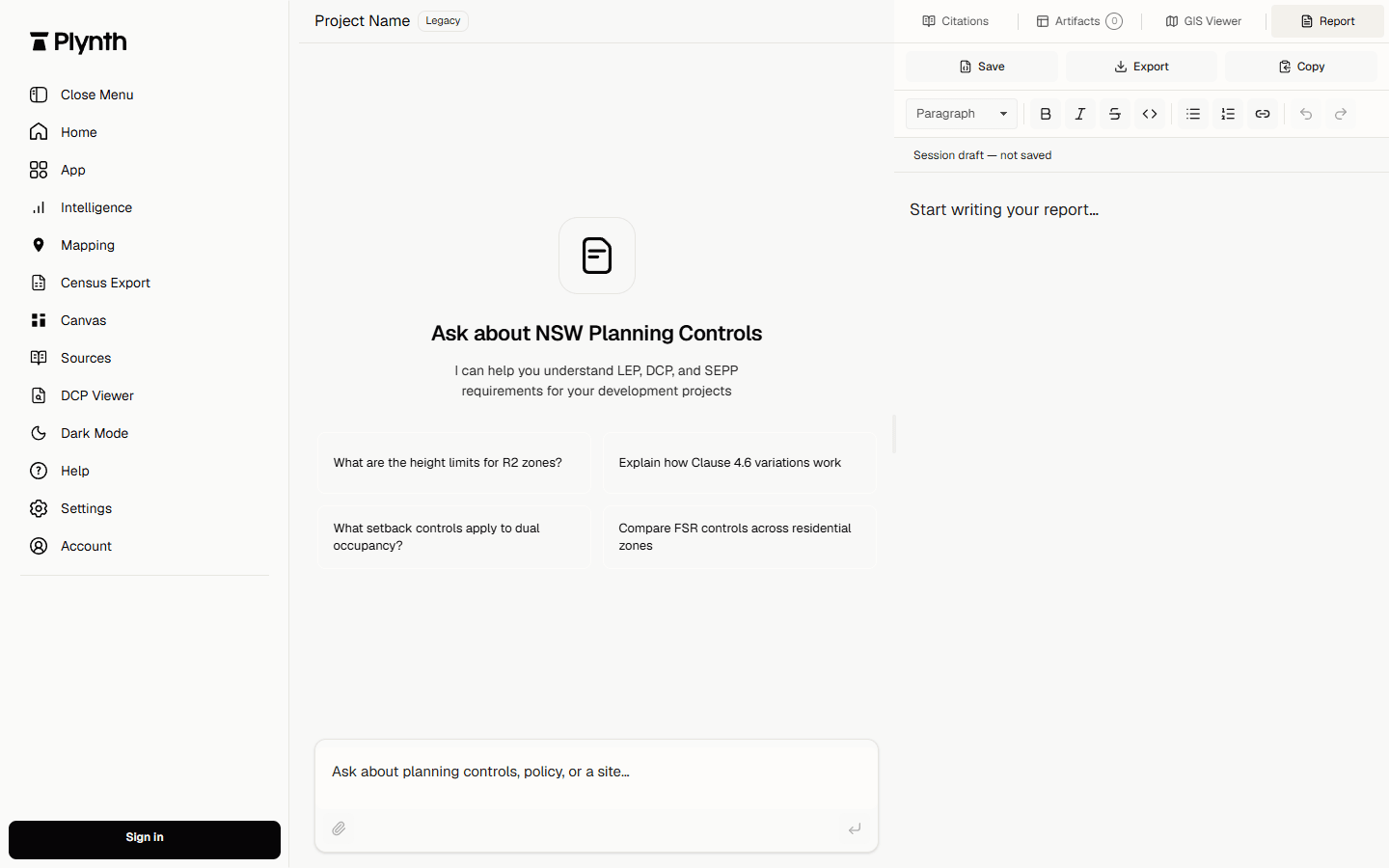
Resolve the parcel and proposal before listing constraints.
A useful early screen begins with the land and the proposal assumption. The same control can matter differently for a subdivision, addition, change of use or larger redevelopment.
Plynth keeps the site identity and stated proposal beside the evidence so the record can be corrected when the question changes.
Record controls, hazards and infrastructure with their source.
Mapped observations should identify the layer or official source, the geography checked and the date of the observation. A boundary intersection is recorded as an observation, not turned into a conclusion without the written rule.
If a source is unavailable or a boundary is ambiguous, the record says so. An empty cell is not silently converted into no constraint.
Use nearby development as context, not an approval forecast.
Development activity can show what has been lodged, assessed or determined around a site when the upstream record is available. It does not establish what will be approved on the subject land.
Place and infrastructure evidence adds context to a planning question; it does not replace a feasibility study or market assessment.
Keep the unresolved questions in the handoff.
The decision register distinguishes observed evidence, matters requiring assessment and evidence that is unavailable. The unresolved column is part of the output, not an error to hide.
That makes the early screen useful as a briefing document for the next site visit, certificate request or professional review.
A due-diligence screen should show what remains unknown.
This evidence contract is aligned with the current Plynth report workflow. It deliberately avoids a single risk score or approval likelihood.
| Subject | Finding | Source | Boundary |
|---|---|---|---|
| Parcel | Observed. The selected lot and working geography are recorded. | Official parcel and planning-map context | Confirm title, survey and legal boundaries outside this screen. |
| Mapped controls | Observed. Selected planning layers stay with the map. | NSW Planning Portal and incorporated maps | Read each observation with the written instrument. |
| Merit and design | Requires assessment. No deterministic result is assigned. | Proposal facts, instrument objectives and professional evidence | Plynth does not decide discretionary merit. |
| Missing evidence | Unavailable. The missing evidence remains an open action. | No verified project source supplied | Obtain the relevant certificate, survey or specialist input. |
What this workflow does not establish.
- The screen does not verify title, ownership, easements, contamination, finance or investment performance.
- It does not replace a section 10.7 planning certificate, survey or qualified project advice.
- Nearby applications and determinations are context, not proof that a similar proposal will be approved.
Check the source and its date position.
These sources support the public explanation and worked specimen. The official publisher remains the authority.